
e-Yantra Research Talks
At e-Yantra, we are committed to fostering a culture of innovation and knowledge-sharing. Our Research Talk Series provides a platform for researchers and staff members to share their work and technical insights related to the ongoing research and projects in the lab. It is also a forum for e-yantra alumni, industry experts, and thought leaders to share insights into cutting-edge technologies. These talks aim to inspire, educate, and connect individuals passionate about technology and innovation. Whether you're a student, professional, or enthusiast, join us to explore the latest advancements, engage with experts, and be part of a community driving the future of technology.
Upcoming Talks
No upcoming events at the moment.
Past Talks
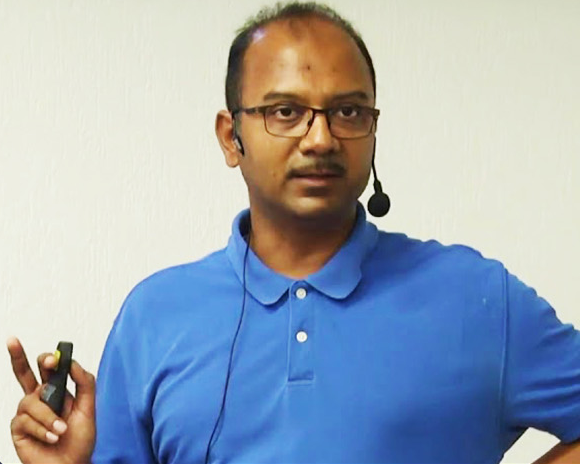
Room Cooling Systems (ACs) Optimization
Abstract:
The presentation covered the evolution and optimization of the CSE@IITB server room cooling systems, highlighting challenges and solutions. It detailed the historical timeline. Issues like overcooling, condensation damage to high-value servers, and unstable temperature control were discussed, along with system failures due to poor maintenance, muddy chilled water, and actuator malfunctions. To address these problems, a custom-built control system using Linux, ESP32 microcontrollers, and PID-based regulation was implemented, improving stability. Future plans include better humidity control, direct PCIe-based I2C communication, and improved power monitoring integration for enhanced efficiency.
About Speaker: Prof. Soumen Chakrabarti is an Indian computer scientist and professor in the Department of Computer Science and Engineering at IIT Bombay, renowned for his contributions to web search, data mining, and graph-based information retrieval. His research includes the CLEVER Web page ranking system, focused crawlers, keyword search on graph databases, and named entity disambiguation. He authored an early book on Web search and mining and has received prestigious honors, including the Shanti Swarup Bhatnagar Prize (2014) and the J. C. Bose National Fellowship (2019). A fellow of INAE, IASc, and INSA, he is also a distinguished alumnus of IIT Kharagpur.
Time: 04:00 PM - 05:00 PM
Are computer systems secure?
Abstract:
Computer architecture breakthroughs over the past two decades have revolutionized how computer performance is measured. Caching, out-of-order execution, and speculative execution have been integrated into almost every modern processor, speeding up computers beyond imagination. The very same ideas and philosophies, however, have opened up new avenues for wholly different classes of vulnerabilities. In this talk, we shall consider the coupling of performance gain and security damage. We will take a close look at how microarchitectural features expose systems to side-channel attacks. Techniques such as Flush+Reload and Spectre that exploit design flaws to retrieve sensitive information from victim processes will be discussed. Through examining the vulnerabilities and their exploitation, we will learn about the performance-security trade-off and the efforts made in this dimension towards building a secure system.
Time: 04:00 PM - 05:00 PM
Career Story
Abstract:
The talk was focused on the work Amrita Aurora is involved in at WhatsApp, how Functional Programming plays a role in it, and her overall experience throughout.
About Speaker: Amrita Aurora is currently working as a Software Developer at Meta (WhatsApp). She is an alumni of e-Yantra. She completed her Master's in Electrical and Computer Engineering from CMU in 2015 and has worked at Oracle, Meta, and now WhatsApp.
Time: 04:00 PM - 05:00 PM
Efforts and issues in publicly available weather data
Abstract:
Abstract: Environmental data can be retrieved from IMD or by installing a local weather station close to the farm. The problem with relying on IMD weather data is its spatial resolution since each district typically has at least one IMD weather station. This makes it difficult to rely on IMD data for farmland solutions far from the IMD station. Installing a local weather station is possible but expensive and often limited in its capability to send weather data to remote/cloud servers due to network limitations. Among the 200+ weather stations available, prices range from Rs. 10,000 to Rs. 2 Lakhs+. One can install a weather station near the farmland based on affordability and use case. Most weather stations have limited capabilities to send and store data to a remote server. They typically consist of two parts: a weather recording unit and a display unit. The display unit, which can be wired or wireless, is used to visualize and store weather data for one day to two years and sometimes can send data to a remote server.
Time: 04:00 PM - 05:00 PM